

Day trading attracts traders looking to profit from short-term price movements within a single trading session. Unlike long-term investing, intraday trading focuses on capturing opportunities that develop over minutes or hours, requiring quick decisions and a well-defined plan.
However, success rarely comes from intuition alone. The most profitable traders rely on proven day trading strategies that help them identify high-probability setups, manage risk, and stay disciplined in fast-moving markets. In this guide, we'll explore the best day trading strategies, explain how they work, and help you choose the approach that best fits your trading style and goals.
1. What Is Day Trading?
Day trading is a popular trading style that involves opening and closing a position within the same day to take advantage of short-term market movements. Traders look for opportunities that develop over a short period and aim to generate small profits from multiple trades. Over time, these gains can potentially grow into a much bigger gain if managed consistently.
One of the main advantages of day trading is that positions are not held overnight, reducing exposure to unexpected news and market volatility outside trading hours. However, profitability depends on having a proven strategy and disciplined execution.
Read More: Swing Trading vs Day Trading: Before You Start Trading, Read This Comparison First
2. How Does Day Trading Work?
Day trading involves opening and closing positions within the same trading session to profit from small market movements. Rather than investing for the long term, day traders focus on short-term opportunities created by price fluctuations and market volatility. The higher the volatility, the greater the potential for both profits and losses.
Because markets can move quickly, successful traders rarely rely on instinct alone. Instead, they use rules-based trading strategies that define when to enter a trade, where to place a stop loss, and when to exit. This structured approach helps manage risk and improve decision-making in fast-paced market environments.
3. What Makes the “Best” Day Trading Strategy?
Not all day trading strategies are created equal. The best strategy is one that can generate consistent results while keeping risk under control. Rather than focusing solely on profits, traders should evaluate a strategy based on several key factors:
- Risk-to-Reward Ratio: A good strategy should offer more potential reward than risk. Many traders aim for at least a 1:2 ratio, meaning they risk $100 to potentially make $200.
- Win Rate: The percentage of trades that end in profit. A high win rate can improve consistency, but it should be considered alongside the risk-to-reward ratio.
- Scalability: A strategy should continue to work as your account grows and position sizes increase.
- Time Required: Some strategies require constant monitoring throughout the day, while others only need a few trades during key market hours.
- Emotional Difficulty: Fast-paced strategies such as scalping can be stressful, while trend-following strategies often require more patience.
- Market Conditions: Some strategies perform best during high volatility, while others work better in ranging or slower markets.
- Capital Requirements: Certain approaches require larger account balances to manage risk effectively, while others can be used with smaller trading accounts.
Ultimately, the best day trading strategy is not necessarily the most profitable on paper. It's the one that matches your goals, risk tolerance, available time, and trading personality while delivering consistent results over the long term.
4. Top 5 Best Day Trading Strategies Traders Use to Win More
4.1. Trend Trading
Trend following is built around one of the most well-known trading principles: “the trend is your friend.” Rather than trying to call market tops or bottoms, trend traders focus on directional price movement and trade in the direction of the prevailing trend. When a stock is making higher highs and higher lows, traders typically look for long opportunities. Conversely, when price forms lower highs and lower lows, they may take short positions to profit from downward momentum.
To identify and confirm trends, traders often rely on day trading indicators such as the Exponential Moving Average (EMA), VWAP, and MACD. For example, a bullish trend setup may occur when the price remains above the 20 EMA and VWAP while the MACD continues to print positive momentum. Many traders wait for a pullback toward these support levels before entering a trade, rather than chasing an extended move.
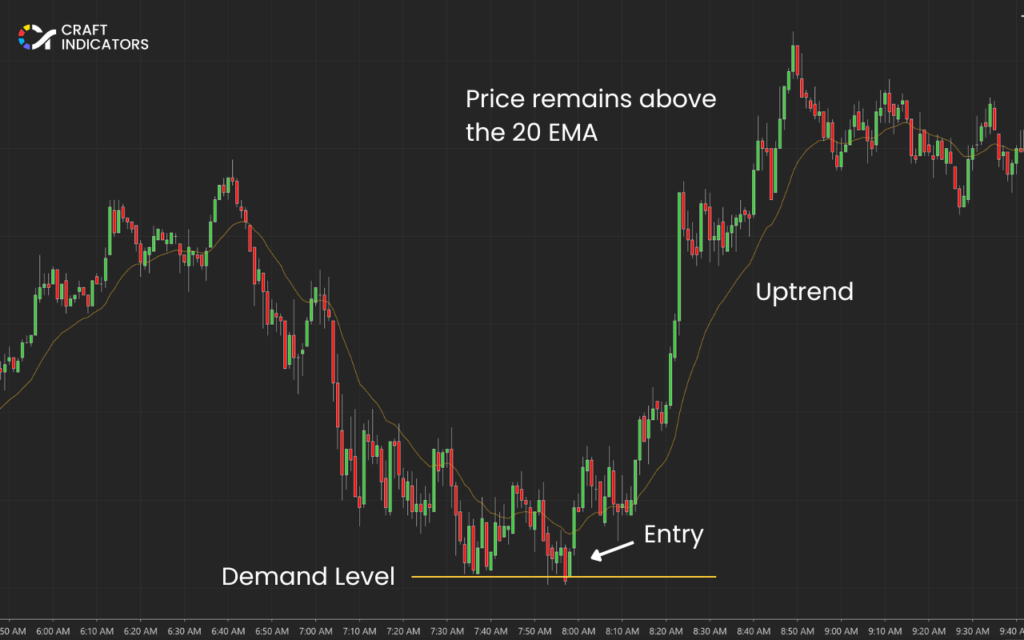
Trend following works best in markets with strong momentum, high trading volume, and clear directional bias. A common setup involves buying after a pullback in an uptrend and placing a stop loss below the recent swing low. The biggest advantage of this strategy is the ability to capture large price moves, but it can struggle during range-bound or choppy market conditions where trends frequently break down.
4.2. Breakout Trading
Breakout trading is a strategy that focuses on identifying and trading price moves beyond key supply and demand levels. The idea is simple: when price breaks out of a well-defined range, it often signals the beginning of a new trend or a significant expansion in volatility. Traders typically look for bullish breakouts above supply to enter long positions, while bearish breakdowns below demand can create short-selling opportunities.
One of the most important elements of breakout trading is volume confirmation. A breakout accompanied by strong trading volume suggests that institutional and retail traders are participating in the move, increasing the likelihood that the breakout will continue. In contrast, breakouts on low volume often lack conviction and are more likely to fail.
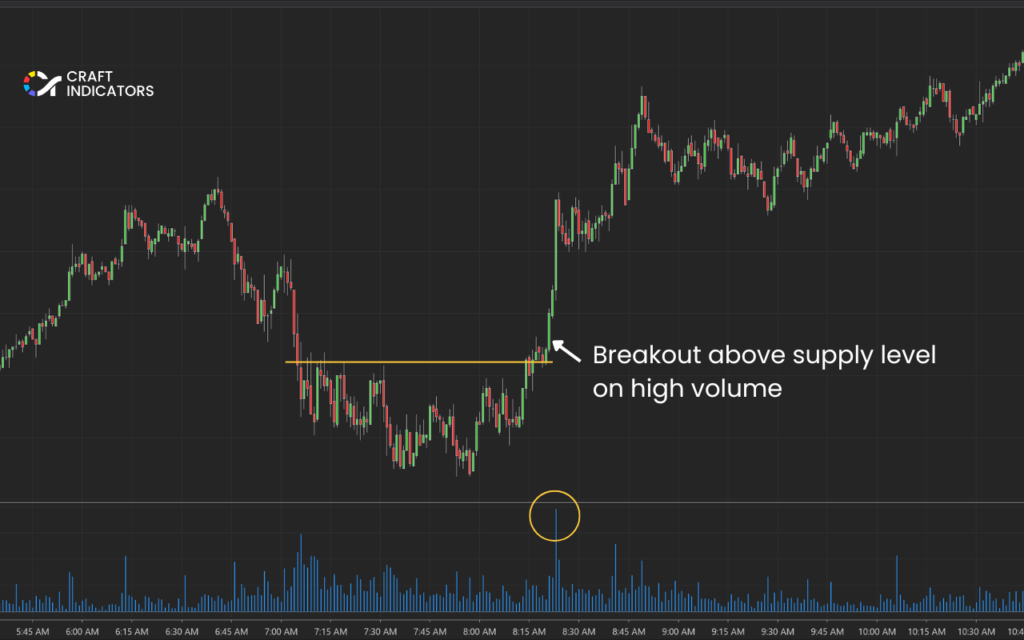
A common variation is the Opening Range Breakout (ORB) strategy, where traders use the high and low of the first 5 to 30 minutes of the trading session as key levels. If price breaks beyond this range with increasing volume, traders look to join the move.
However, traders should be aware of fake breakouts, where price briefly moves above supply or below demand before reversing back into the range. To reduce this risk, many traders wait for a candle close beyond the breakout level or a successful retest before entering a position.
4.3. Scalping
Unlike trend traders who may hold positions for several hours, scalpers aim to profit from small intraday price fluctuations by entering and exiting trades quickly. The goal is not to capture a large move but to take advantage of multiple small moves throughout the session. Some active scalpers may execute dozens or even hundreds of trades in a single day.
Speed is critical when using this strategy. Trades are often executed within minutes, or even seconds, using 1-minute and 5-minute charts to identify short-term momentum. Because positions are opened and closed so quickly, high trading volume is essential for ensuring fast order execution and minimizing delays.
Most scalpers rely on short-term charts and technical indicators to find entry opportunities. Moving averages are particularly popular because they help identify the direction and strength of a trend. For example, traders may use a combination of the 5 EMA, 8 EMA, and 13 EMA to spot momentum and potential continuation setups.
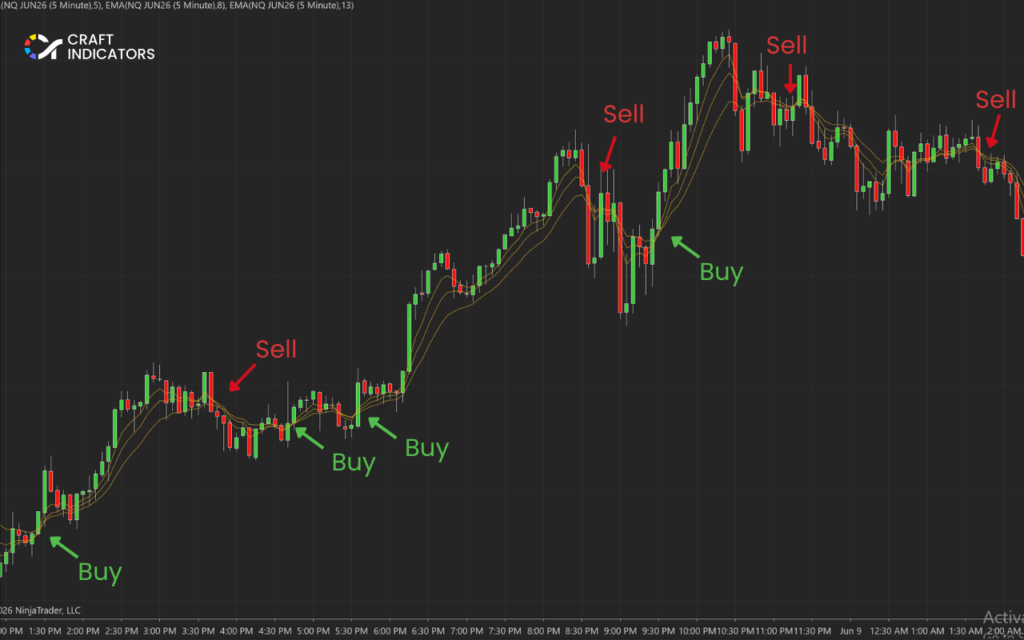
Scalpers must also pay close attention to spread and slippage, as small execution costs can significantly impact profitability when trading frequently. Since one large loss can wipe out multiple winning trades, successful scalpers rely on strict risk management and predefined exit rules to protect their capital.
4.4. News Trading
Financial markets can react dramatically to major news events, which is why many day traders build strategies around economic announcements and corporate updates. Events such as FOMC meetings, CPI releases, earnings reports, and employment data often create sharp price movements as investors adjust their expectations.
A positive earnings surprise, for example, may trigger strong buying pressure, while weaker-than-expected inflation data can influence the broader market direction. The appeal of news trading lies in the potential to capture large intraday moves in a short period.
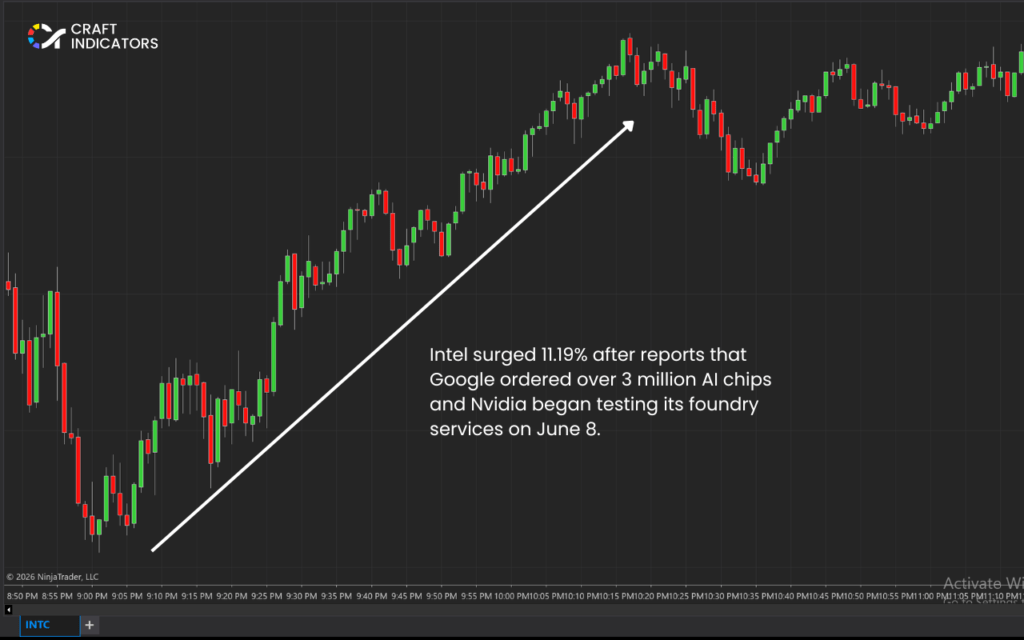
However, volatility can be unpredictable, and prices may reverse quickly after the initial reaction. To reduce this risk, professional traders rarely chase the first move. Instead, they wait for volume to confirm the direction and look for setups after the market has absorbed the news.
4.5. Mean Reversion
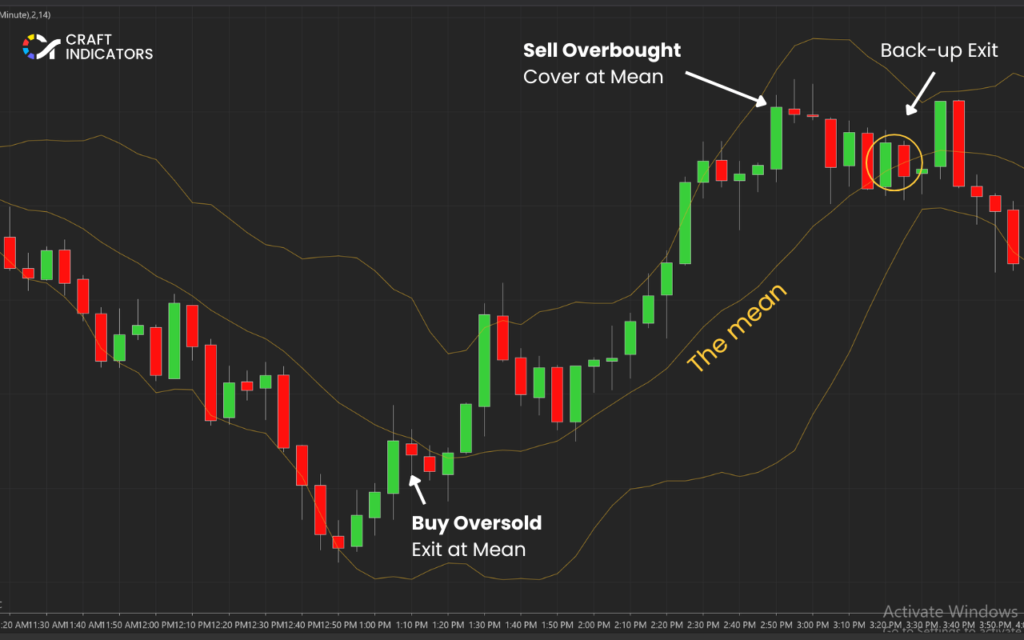
Not every price move is sustainable. Mean reversion traders look for situations where the market has pushed too far in one direction and may be due for a pullback.
This strategy assumes that prices eventually return to their historical average after periods of excessive buying or selling. Indicators such as RSI and Bollinger Bands can help identify stretched conditions, while reversal candlesticks are often used as entry signals.
A common setup involves buying after an oversold reading or shorting after an overbought rally. While effective in range-bound markets, mean reversion setups can fail quickly during strong trends, where momentum often outweighs the likelihood of a reversal.
5. Which Market Is Best for Day Trading?
The best market for day trading depends on your experience level, available capital, risk tolerance, and preferred trading hours. Each market offers different levels of volatility, liquidity, and leverage, which can significantly impact your trading results.
| Market | Best For | Popular Assets | Capital Requirement | Key Advantages |
| Futures | Intermediate and advanced traders | E-Mini S&P 500 (ES), Micro E-Mini (MES), NASDAQ 100 (NQ), Crude Oil (CL) | Low to Moderate ($500-$5,000+) | High liquidity, leverage, nearly 24-hour trading, no PDT rule |
| Forex | Beginners and traders with limited capital | EUR/USD, GBP/USD, USD/JPY | Low ($100-$1,000+) | Largest financial market, high liquidity, 24/5 trading |
| Stocks | Traders focused on company news and earnings | NVDA, TSLA, MSFT, AAPL | High ($25,000+ for active U.S. day traders) | Strong volatility, abundant research, earnings-driven opportunities |
| Crypto | Aggressive traders are comfortable with risk | Bitcoin (BTC), Ethereum (ETH), Solana (SOL) | Low ($100+) | 24/7 access, high volatility, no market close |
| Options | Advanced traders seeking leverage | SPY, QQQ, AAPL, TSLA options | Moderate ($2,000+) | Defined risk, leverage, multiple trading strategies |
For beginners, Forex and Micro Futures are often the easiest markets to start with because they require less capital and offer excellent liquidity.
Stock day trading remains popular, but active traders in the United States should be aware of the Pattern Day Trader (PDT) rule, which requires a minimum account balance of $25,000.
Traders seeking maximum volatility often gravitate toward cryptocurrency markets, while experienced traders frequently prefer futures due to their leverage, liquidity, and extended trading hours.
Read More: 8 Futures Trading Strategies Explained with Real Examples
6. Risk Management Rules Most Traders Ignore
Many traders spend countless hours searching for the best day trading strategy, but risk management often has a bigger impact on long-term profitability than trade entries. Even a profitable strategy can fail if losses are not controlled. Successful traders focus on protecting capital first and generating profits second.
Some of the most important risk management rules include:
- The 1% Rule: Risk no more than 1% of your trading account on a single trade.
- Stop Losses: Always define an exit point before entering a position to limit potential losses.
- Position Sizing: Calculate the ideal position size based on your stop-loss level with the formula:
- Daily Loss Limits: Set a maximum daily loss and stop trading once it is reached to avoid emotional decisions.
- Risk-to-Reward Ratio: Aim for setups that offer greater potential reward than risk, such as a 1:2 or 1:3 ratio.
Position size = Money at Risk Stop–Loss Size
By following these rules consistently, traders can survive losing streaks, reduce emotional trading, and preserve capital for future opportunities.
7. How to Backtest a Day Trading Strategy
Before using real money, it's important to test your strategy to see if it works.
Step 1: Define Your Rules
Clearly document your entry criteria, stop-loss placement, profit target, and position sizing rules. Avoid vague conditions that can be interpreted differently.
Step 2: Test Historical Data
Use charting software or tools such as NinjaTrader Replay to review past market sessions and execute trades according to your rules. Record every trade exactly as you would take it in a live market.
Step 3: Track Key Metrics
After collecting at least 50 to 100 trades, calculate your win rate, average winning trade, and average losing trade.
Step 4: Calculate Expectancy
Use the formula below to determine whether the strategy is profitable over time:
Expectancy = (Win Rate x Avg Win) – (Loss Rate x Avg Loss)
A positive expectancy suggests the strategy has a statistical edge.
Step 5: Forward Test on a Demo Account
If the results look promising, test the strategy in a demo account before risking real capital.
conclusion
The best day trading strategy is not the one with the highest win rate or the most exciting setup. It is the strategy you can execute consistently with discipline and proper risk management. Some traders thrive with fast-paced scalping. Others perform better using patient trend-following strategies. The key is finding a method that fits your personality, schedule, and emotional tolerance.
Also, follow us for all the promotions and other useful topics:
- Facebook: www.facebook.com/craftindicators
- Instagram: www.instagram.com/craftindicators
