

In modern trading, clarity is everything. The Supertrend indicator provides that clarity by acting as a straightforward trend-following tool that highlights market trends in real time. The Supertrend strategy uses this indicator to help traders detect shifts in direction and manage trades more efficiently. Because of its simplicity, it has become popular among intraday traders seeking structured decision-making.
This article will walk you through the logic behind the Supertrend strategy. We also show you how to turn this tool into actionable trading setups that you can confidently apply in active markets.
1. Supertrend Indicator Explained
Before we go further, what is the Supertrend indicator?
The Supertrend indicator is one of the easiest tools for traders to read and use. It was created to help traders see the current trend and find good entry and exit points. This tool works on many markets like futures, stocks, forex, crypto, and commodities. What makes it useful is that it explains trend direction with only one line on the chart.
Many new traders like this indicator because it is easy to read. The line changes color based on trend direction and stays on the price chart. It doubles as a dynamic level of support or resistance and gives straightforward clues for entering or exiting trades.
2. How Supertrend Indicator Is Built
The Supertrend indicator has two main parts. First is the average true range (ATR), which measures how much price moves during a period. More volatile markets create larger ATR readings. Second is the multiplier, which controls how far away the Supertrend line sits from price.
Usually, traders use an ATR period of 10 and a multiplier of 3. These are common settings that work across many timeframes and assets. If you make the multiplier bigger, the indicator will give fewer signals and stay farther from price. If you make it smaller, it will sit closer to price and give more signals, but also more false ones.
The Supertrend builds two bands, one above price and one below price, and then decides which side to show based on where the last price closed. If the price closes above the upper band, then the lower band becomes the active Supertrend line and the trend turns up. If price closes below the lower band, the upper band becomes the active line and the trend turns down.
3. Reading the Signals
On a chart, Supertrend indicator is easy to read. When the line is below price and colored green, the market is likely in an uptrend. When the line flips above price and turns red, it often shows a downtrend. These flips act like trading signals.
A basic way to use the Supertrend indicator is to enter a trade after a confirmed flip. If price moves above the line and the line turns green, a trader might buy. If price moves below and the line turns red, a trader might sell. Always wait for candles to close before acting to avoid fake signals.
Many traders also use the Supertrend line as a stop-loss guide. For long trades, stops can go below the line. For short trades, stops can go above it. This gives a dynamic exit point that moves with the trend.
4. Applying the Supertrend Strategy to Real Market Conditions
Before applying any Supertrend strategy, you must first evaluate the market environment. The Supertrend indicator performs best when price is clearly trending. If the market is moving sideways, signals can become unreliable and lead to inconsistent results. That is why the first step is always to determine whether strong market trends are present.
Once a trend is confirmed, you can begin structuring your approach. Your strategy will depend on the timeframe you trade. An intraday setup requires faster signals and lower timeframes, while swing trading focuses on broader moves.
In this guide, we will use the Versatile Supertrend Indicator for NT8 as our real-market example because of its flexibility and advanced customization features. Built specifically for NinjaTrader 8, it allows traders to fine-tune ATR settings, multipliers, and visual parameters to match different trading styles and market conditions.
4.1. Breakout Trading Strategy
The goal of this strategy is to catch a new trend early. Breakouts happen when price pushes beyond important support or resistance levels.
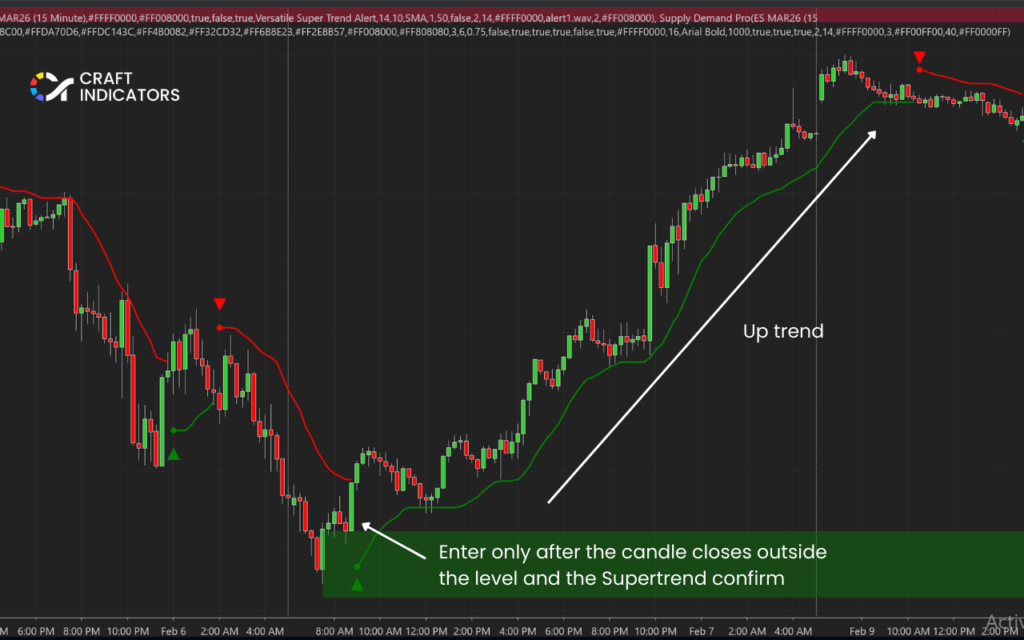
Start by marking clear horizontal levels where price has reacted before. We use the Supply and Demand Pro Indicator for NT8 as confirmation. Wait patiently. Do not enter before the breakout happens.
When price breaks the level and closes beyond it, watch the Supertrend. If it flips in the same direction, you have confirmation.
Enter only after the candle closes outside the level and the Supertrend confirms. For long trades, place the stop-loss below the breakout low. For short trades, place it above the breakout high.
For take-profit, you can target the next swing high or low. You can also use a measured move based on the previous range.
This strategy works best in strong trending conditions. The downside is false breakouts, especially during low volatility.
4.2. Pullback Trading Strategy
The goal here is to enter in the direction of the main trend after a temporary retracement.
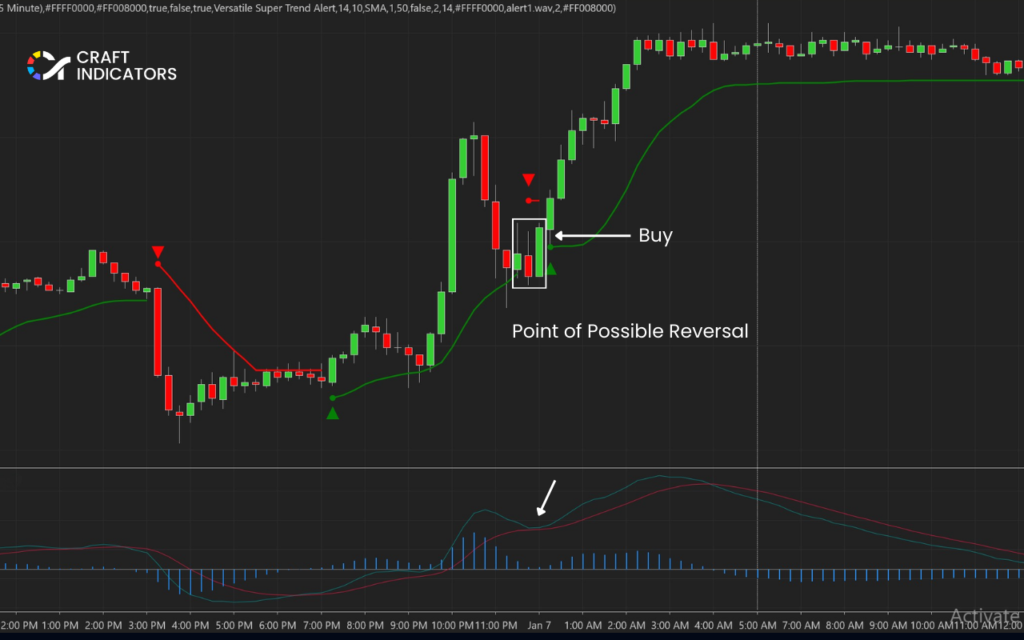
First, identify the trend using the Supertrend. If the line is below price and green, the trend is up. If it is above and red, the trend is down.
Wait for price to pull back toward support in an uptrend or resistance in a downtrend. Do not chase price when it is extended.
You can confirm the pullback using the Relative Strength Index (RSI) or the MACD. Look for momentum to slow down and then turn back in the trend direction.
Enter when price shows signs of continuation, such as strong rejection candles or higher lows in an uptrend.
Place the stop-loss below the recent swing low in an uptrend or above the swing high in a downtrend.
This method is often less noisy than breakout trading because you are entering after confirmation of strength, not at the moment of expansion.
4.3. Reversal Trading Strategy
This strategy focuses on spotting when a trend is weakening and about to change.
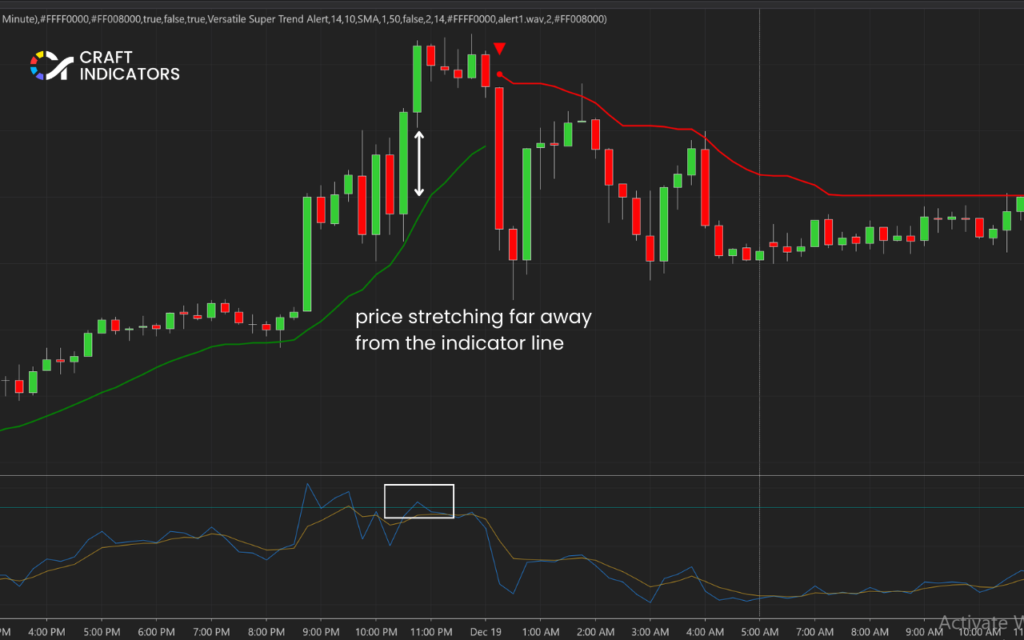
Look for a Supertrend color flip combined with price stretching far away from the indicator line. When price becomes extended and then sharply returns, it may signal exhaustion.
Divergence between price and momentum indicators can strengthen the signal. A strong reversal candle near key support or resistance adds more confidence.
For example, price drops sharply, moves far below the Supertrend line, then closes back above it with a strong bullish candle. The Supertrend flips green. That is your signal flow.
Because reversals are risky, use tighter stops. Place them beyond the recent extreme. Do not give the trade too much room.
Avoid using this strategy in choppy or sideways markets. In those conditions, flips happen too often.
4.4. Range / Range Breakout Strategy
Markets do not trend all the time. Sometimes they move sideways between clear support and resistance levels.
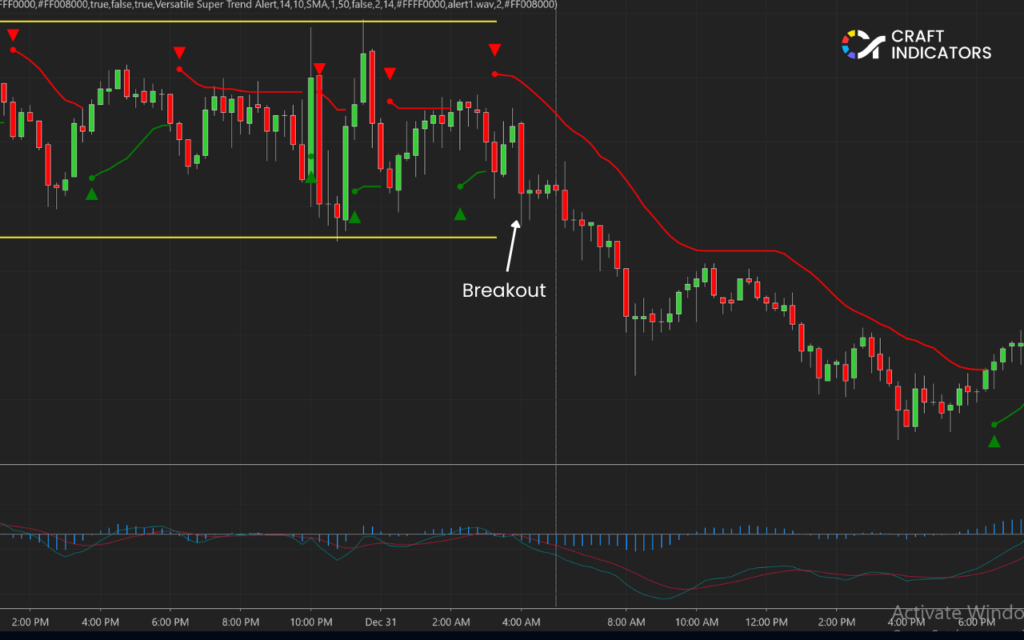
Define the range first. Draw horizontal lines where price keeps bouncing.
Do not trade inside the range. Wait for a true breakout.
A valid entry happens when price closes clearly outside the range and the Supertrend confirms the direction. Always wait for candle close. This helps reduce fake breakouts.
Take-profit can be set based on the height of the range projected upward or downward.
The Supertrend helps avoid whipsaws because it forces you to wait for directional confirmation instead of reacting to every small move.
5. Common Mistakes & How to Avoid Them
One common mistake is taking every Supertrend flip without context. Not every flip means a strong trend.
Another mistake is trading during sideways markets. Supertrend works best when price moves clearly in one direction.
Ignoring risk management is dangerous. Always protect your capital.
Many traders also forget confirmation. Combining structure, momentum, and trend improves results.
Final Thoughts
There is no single “best” strategy. Choose one method that fits your personality. Test it on historical charts. Practice on a demo account before risking real money. Consistency matters more than complexity. Follow your rules. Manage risk. Stay disciplined.
The Supertrend is simple, but when used correctly, it can become a powerful part of your trading system.
Also, follow us for all the promotions and other useful topics:
- Facebook: www.facebook.com/craftindicators
- Instagram: www.instagram.com/craftindicators
