

In trending markets, having a reliable trend-following indicator can make a significant difference in trading results. Intraday traders widely favor the Supertrend indicator for its ability to generate clear and timely buy and sell signals. By combining price action with volatility, it helps traders stay on the right side of the market while avoiding unnecessary trades.
Although the indicator is easy to use, its real strength lies in proper interpretation and strategy development. In this guide, we will cover how the Supertrend indicator works, how to identify high-quality signals, and how to incorporate it into an effective Supertrend trading strategy.
1. What Is the Supertrend Indicator?
The Supertrend indicator is a trend-following technical tool designed to identify trending markets using price action and volatility. It plots a dynamic line on the price chart to signal bullish or bearish conditions. By adapting to market volatility, the Supertrend indicator helps traders clearly follow trend direction and generate reliable trading signals across different market conditions.
2. How Does the Supertrend Indicator Work?
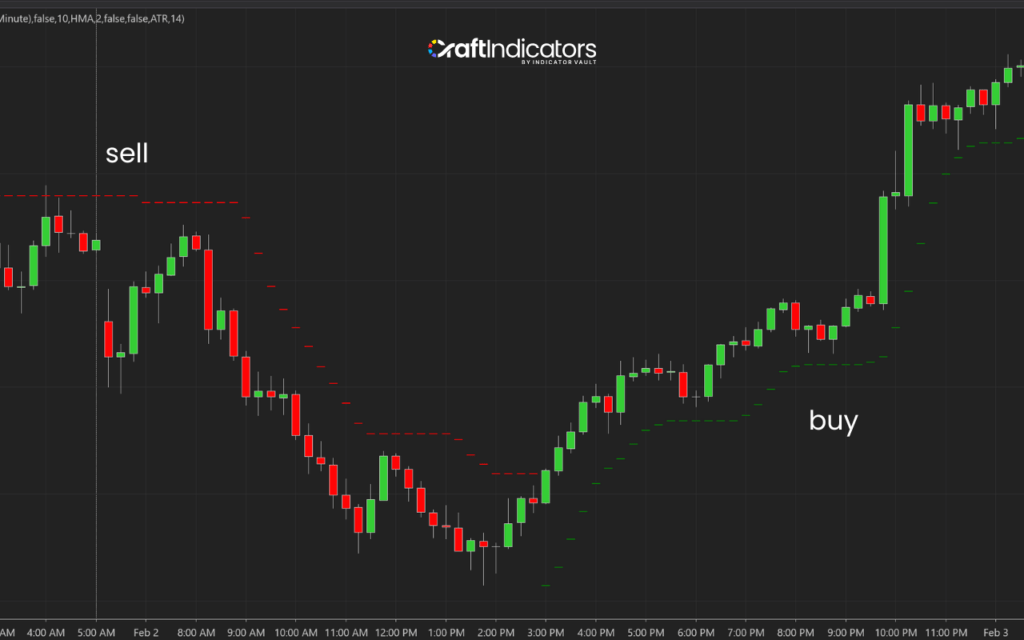
The Supertrend indicator works by plotting a single line on the price chart to show the current market trend. This line moves above or below the price depending on market direction, making it easy for traders to identify whether the market is bullish or bearish.
The indicator uses the Average True Range (ATR) to measure volatility and adjusts its position based on price movement. When the price stays above the Supertrend line, it signals an uptrend and potential buying opportunities. When the price moves below the line, it indicates a downtrend and possible selling signals.
3. Supertrend Indicator Formula
The calculation process focuses on creating upper and lower bands around price, which later form the Supertrend line.
First, the ATR is calculated over a user-defined period (commonly 10 or 14). ATR measures how much price fluctuates over time, making it the core component that allows the Supertrend indicator to adapt to changing volatility.
Next, the basic upper and lower bands are calculated using the midpoint of price (High + Low ÷ 2), adjusted by the ATR multiplier:
- Upper Band = (High + Low) ÷ 2 + (Multiplier × ATR)
- Lower Band = (High + Low) ÷ 2 − (Multiplier × ATR)
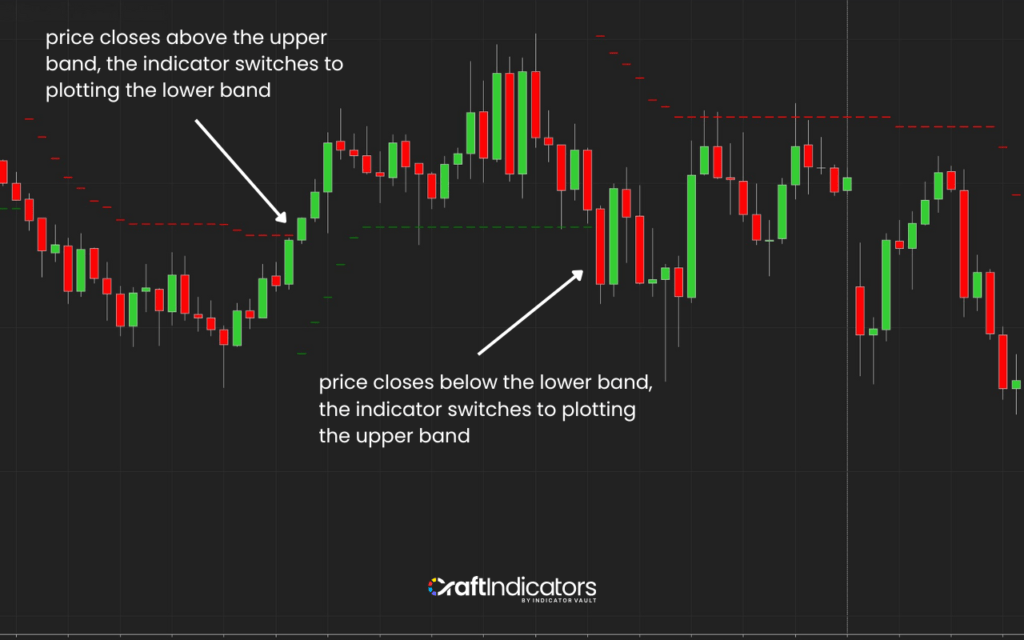
These basic bands are then refined into the final Supertrend line using trend-based logic. When the price closes above the upper band, the indicator switches to plotting the lower band, signaling an uptrend. Conversely, when the price closes below the lower band, the indicator switches to plotting the upper band, indicating a downtrend.
The final Supertrend line switches between the upper and lower band depending on price position. When price stays above the line, the indicator signals an uptrend. When price falls below the line, it signals a downtrend, providing traders with clear and reliable trend signals.
4. Why Is the Supertrend Indicator Important for Traders?
The SuperTrend indicator is important because it helps traders understand how to use trend direction to stay aligned with the dominant market movement, which is a core principle of successful trading. By clearly showing whether the market is trending upward or downward, it reduces the risk of trading against momentum and improves trade consistency and risk management.
Another major benefit is that Supertrend helps remove emotional bias from trading decisions. Instead of guessing market direction, traders can rely on rule-based signals generated by the indicator. It is also useful for defining entry points, exit levels, and trailing stop-losses, making it a valuable tool for both active traders and long-term market participants.
5. Strengths and Limitations of the Supertrend Indicator
5.1. Strengths
The Supertrend indicator is a trader’s favorite for the following strengths:
- The Supertrend indicator is simple and intuitive, making it easy to use even for beginners. It offers clear visual buy and sell signals directly on the price chart.
- It performs exceptionally well in trending markets, helping traders identify and stay aligned with the prevailing market direction.
- The indicator adapts to market volatility using ATR, allowing it to respond dynamically to changing price conditions.
- It can be applied across multiple timeframes and asset classes, making it suitable for intraday traders, swing traders, and long-term investors.
- The Supertrend indicator can also assist with risk management by acting as a guide for stop-loss and trailing stop placement.
5.2. Limitations
However, the Supertrend indicator has certain limitations:
- In sideways or choppy markets, the indicator may generate false signals, leading to frequent whipsaws.
- As a trend-following tool, it can lag behind price movements, causing slightly delayed entries or exits.
- Finding the optimal ATR period and multiplier can be challenging, as ideal settings may vary across markets and timeframes.
- The Supertrend indicator is not designed to be used on its own and works best when combined with other indicators or price action analysis.
Free: Versatile SuperTrend Indicator for NinjaTrader 8 (Limited-Time Gift)
To help traders get more out of trend-following strategies, we’re offering our Versatile SuperTrend Indicator for NinjaTrader 8 completely free for a limited time.
Unlike the traditional SuperTrend, this enhanced version is designed with greater flexibility, cleaner signals, and improved adaptability to different market conditions. It allows traders to fine-tune parameters more precisely, reduce noise in choppy markets, and apply the indicator across multiple trading styles, from intraday to swing trading.
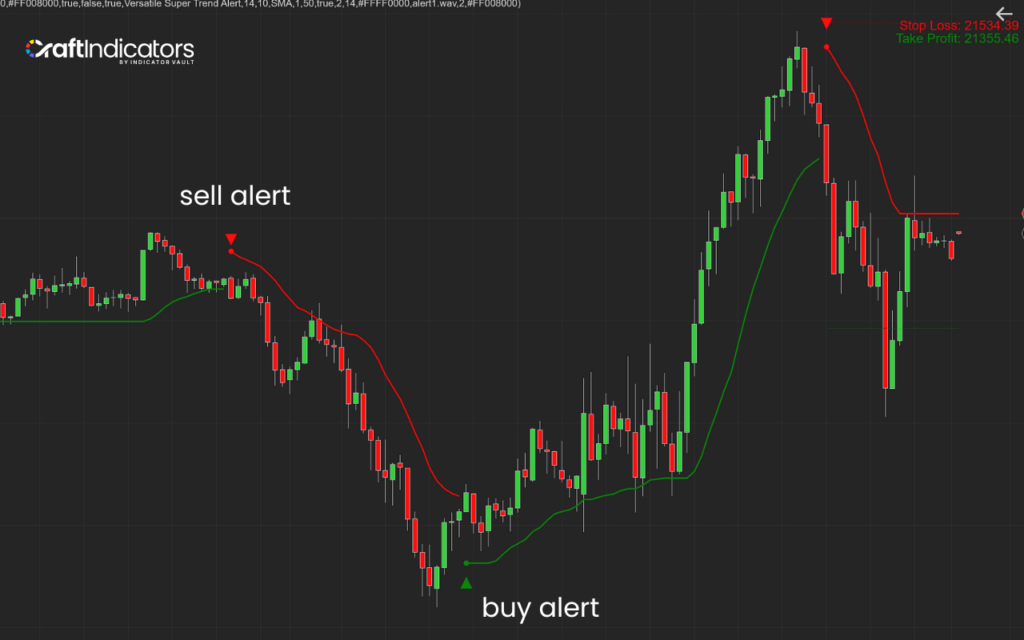
This free release is a perfect way to experience the added control and performance of a professional-grade SuperTrend. For traders who want even more advanced features, this indicator also serves as a gateway to our premium tools designed to take your trading to the next level.
Conclusion
For traders seeking a simple yet reliable trend-following tool, the Supertrend indicator offers an excellent starting point. Its visual signals make trend identification easier, especially in trending markets. With thoughtful parameter adjustments and additional confirmation, traders can use the Supertrend indicator to build a structured and disciplined trading approach.
FAQs
1. What is the Supertrend indicator used for?
The Supertrend indicator is used to identify the overall market trend and generate buy or sell signals. It helps traders determine whether an asset is in an uptrend or a downtrend and is commonly used for trend-following strategies, entry and exit signals, and trailing stop placement.
2. Is the Supertrend indicator accurate?
The Supertrend indicator can be accurate in trending markets, where price moves consistently in one direction. However, like all technical indicators, it is not perfect and may produce false signals in sideways or choppy market conditions. Its accuracy improves when combined with other indicators or price action analysis.
3. What are the best Supertrend indicator settings?
The most commonly used Supertrend settings are an ATR period of 10 and a multiplier of 3. These values provide a good balance between sensitivity and reliability. Shorter periods or lower multipliers create more signals but increase noise, while higher values reduce false signals but may delay entries.
4. Which timeframe is best for the Supertrend indicator?
The Supertrend indicator works across all timeframes, from intraday charts to long-term setups. Lower timeframes are popular with day and intraday traders, while higher timeframes are preferred by swing and position traders. The best timeframe depends on your trading style and risk tolerance.
5. Does Supertrend repaint?
No, the Supertrend indicator does not repaint. Once a candle closes, the Supertrend line and its signal remain fixed. However, signals may change during an active candle, which is why many traders wait for candle closure before making trading decisions.
Don’t forget follow us to get more interesting news as well as great promotions:
Find this article useful? Share this blog with your friends on social media!
