
Day trading takes place in fast-paced environments where traders must make quick decisions based on constantly changing market conditions. In intraday trading, positions are opened and closed within the same day, often lasting only minutes or hours. Because of this short-term nature, traders rely heavily on technical analysis and indicators to interpret price movements in real time.
The best indicators for day trading act as effective tools that analyze price action, volume, and volatility to reveal potential trends, momentum shifts, and optimal entry or exit points. These technical indicators help traders navigate the rapid fluctuations typical of intraday trading.
In this guide, we’ll explore some of the best day trading indicators and explain how they work. We'll also show how traders use these technical tools to develop effective strategies for short-term trading opportunities.
1. What Are Day Trading Indicators?
Day trading indicators are mathematical calculations based on historical price, volume, or open interest data. These indicators help traders interpret market behavior and identify potential trading opportunities.
Unlike long-term investors, day traders need tools that react quickly to market changes. Indicators help them:
- Identify market trends
- Measure momentum
- Detect overbought or oversold conditions
- Confirm breakouts or reversals
- Analyze trading volume
When used correctly, indicators can provide valuable signals that help traders make faster and more informed decisions.
Types of Indicators Used in Day Trading
Most technical indicators fall into four main categories:
- Trend Indicators: These indicators help traders determine the overall direction of the market. Trend indicators are useful for identifying whether the market is moving upward, downward, or sideways.
- Momentum Indicators: Momentum indicators measure the speed of price movements and help traders identify potential reversals or continuation patterns.
- Volatility Indicators: Volatility indicators measure how much the price of an asset fluctuates over time.
- Volume Indicators: Volume indicators analyze trading activity and confirm whether a price movement is supported by strong market participation.
Understanding these categories makes it easier to choose the best indicators for day trading strategies.
2. Top Day Trading Indicators Every Trader Should Use
2.1. Moving Average (MA)
Moving averages help day traders quickly identify the direction of a market trend by smoothing out short-term price fluctuations. They are calculated by averaging an asset’s price over a specific number of periods and plotting that value on the chart.
In day trading, traders commonly use the Simple Moving Average (SMA) and Exponential Moving Average (EMA). The SMA treats all price points equally, while the EMA gives more weight to recent prices, making it more responsive in fast-moving markets.
Why Traders Use Moving Averages
Day traders use moving averages to identify trend direction and time their entries. A common approach is to place a short-term moving average (such as the 9-EMA or 20-EMA) on a 1-minute or 5-minute chart.
When the price stays above the moving average and repeatedly pulls back to it before bouncing, traders often interpret this as a trend continuation setup and look for long entries near the MA.
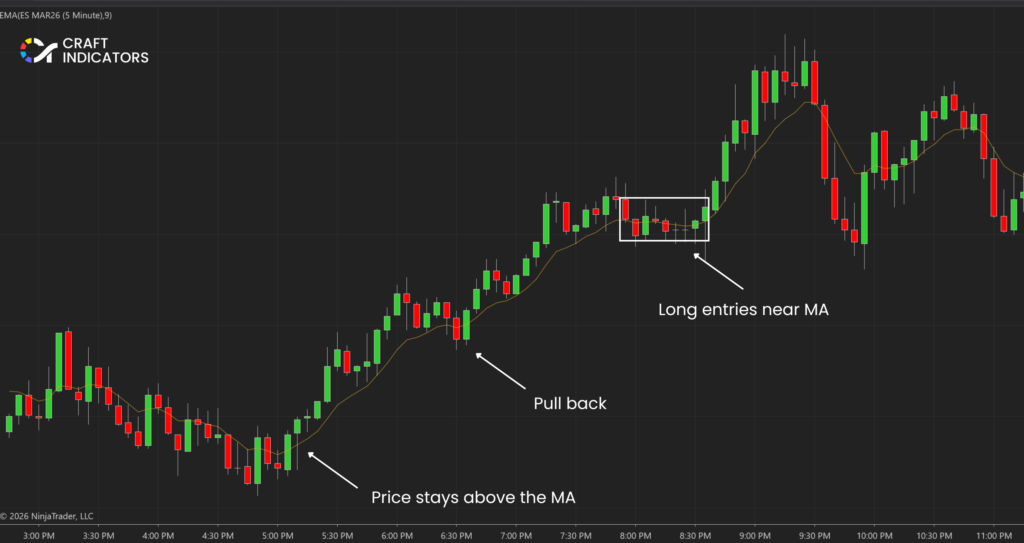
Conversely, if the price remains below the moving average and rallies into it before dropping again, traders may use that area as a short entry.
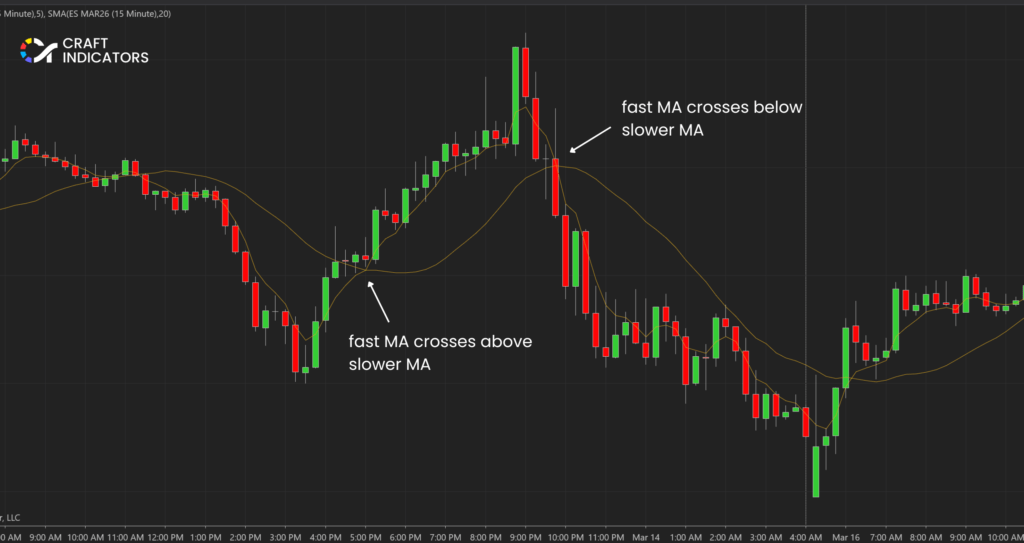
Moving averages are also used for crossover signals. For example, when a fast MA crosses above a slower one (like the 5-EMA crossing the 20-SMA), it may indicate increasing bullish momentum, while the opposite crossover can signal growing selling pressure.
Advanced Alternative
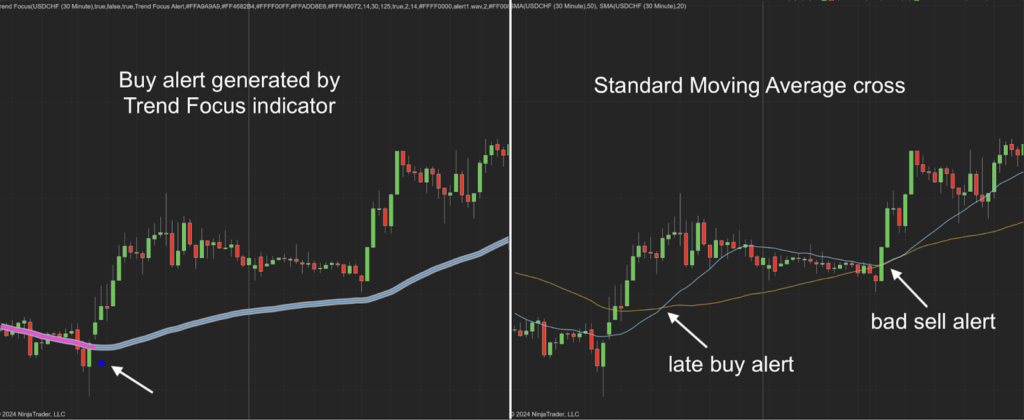
For traders looking to go beyond traditional moving averages, Trend Focus for NinjaTrader 8 offers a more advanced approach to trend analysis. Unlike standard MAs, it reduces lag and filters out market noise, helping traders spot trends earlier and more clearly.
With non-repainting alerts and flexible use as both a trend filter and entry tool, it provides more precise and reliable decision-making in fast-moving markets.
2.2. Relative Strength Index (RSI)
The Relative Strength Index (RSI) is a momentum indicator commonly used in day trading to measure how quickly and strongly prices are moving. Developed by J. Welles Wilder Jr., the RSI ranges from 0 to 100 and is usually calculated using the last 14 periods of price data.
It works by comparing how much the price has gone up versus how much it has gone down during that period. If recent price increases are stronger than decreases, the RSI moves higher. If losses are stronger, the RSI moves lower. This helps traders quickly see whether buying pressure or selling pressure is currently stronger in the market.
How Day Traders Use RSI
In real trading, day traders watch key RSI levels to identify potential opportunities.
- When the RSI rises above 70, the market may be considered overbought, meaning the price has moved up quickly and could be due for a short-term pullback.
- When the RSI falls below 30, it signals oversold conditions, suggesting the price may rebound.
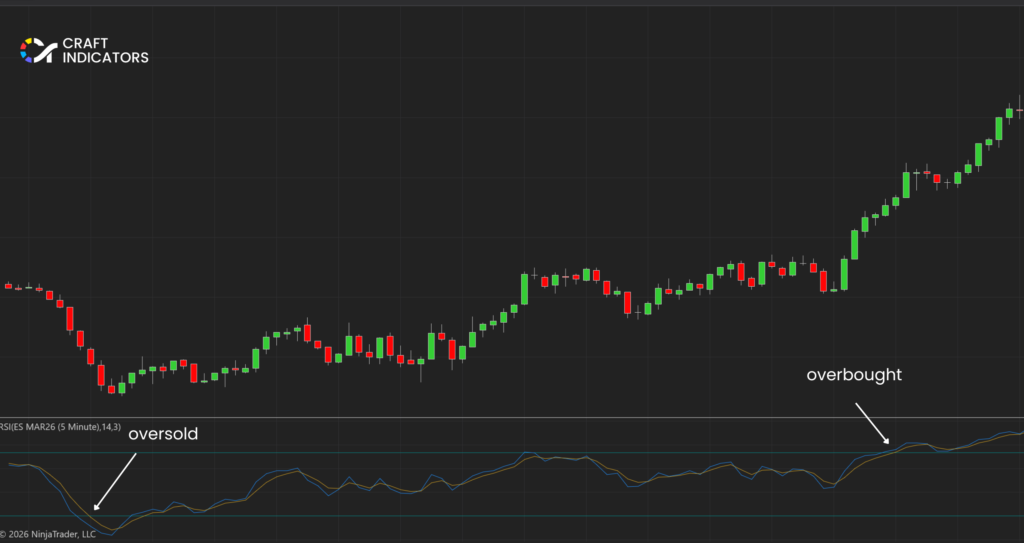
Traders also use RSI to confirm trend strength or spot divergence, where price makes a new high or low but RSI does not, potentially signaling a trend reversal.
Advanced Alternative
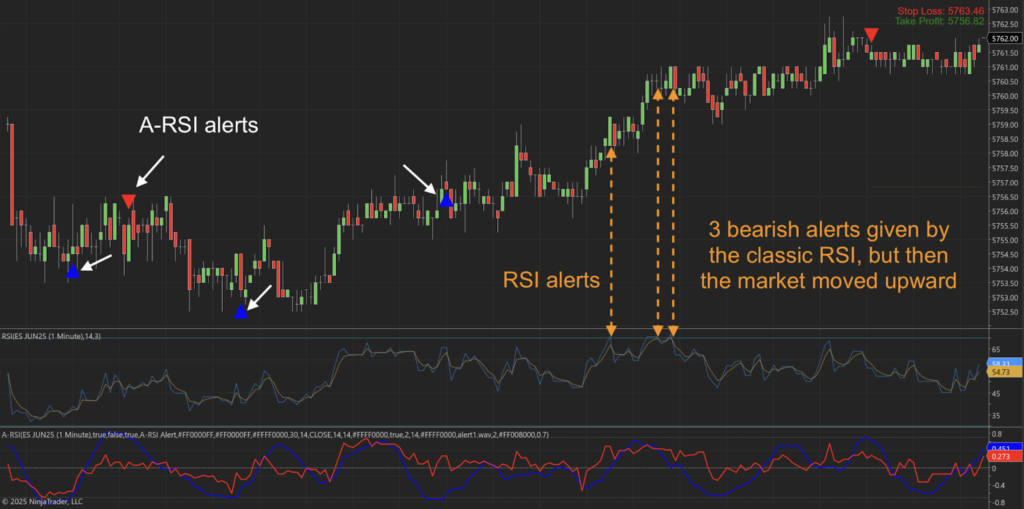
The standard RSI is useful, but it can sometimes lag or produce noisy signals in fast markets. A-RSI for NinjaTrader 8 improves on this by delivering more precise momentum readings, helping identify pullbacks and reversals with greater clarity.
Its enhanced responsiveness allows for better timing, especially in short-term trading conditions where accuracy matters most.
2.3. Moving Average Convergence Divergence (MACD)
The Moving Average Convergence Divergence (MACD) is a momentum indicator that helps traders identify changes in trend strength and direction. It works by comparing two exponential moving averages (EMAs) of price to show whether momentum is increasing or decreasing. The MACD line is calculated by subtracting the 26-period EMA from the 12-period EMA, which highlights the difference between short-term and longer-term price movement.
A second line, called the signal line, is a 9-period EMA of the MACD line and is used to generate trading signals. The histogram displays the gap between the MACD line and the signal line, visually showing whether momentum is strengthening or weakening.
Common MACD Signals
Traders watch for several key signals:
- MACD crossover: When the MACD line crosses above the signal line, it may indicate bullish momentum.
- Bearish crossover: When the MACD line crosses below the signal line, it may indicate bearish momentum.
- Divergence: When price and MACD move in opposite directions, a trend reversal may be approaching.
Advanced Alternative
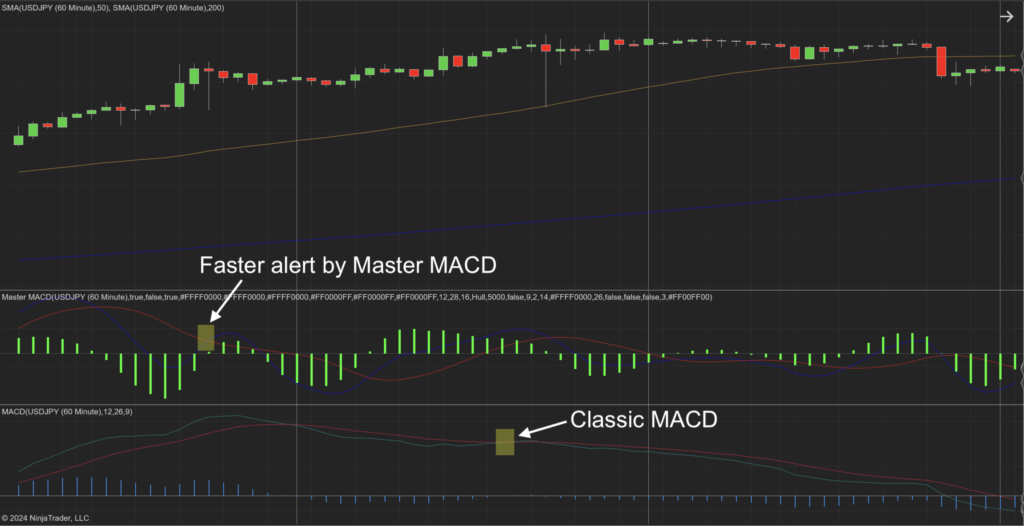
An enhanced version of the classic MACD, Master MACD for NinjaTrader 8 is designed to deliver faster and more responsive momentum signals in real trading. By using a more adaptive moving average, it reduces lag and reacts quicker to market changes, helping identify trends, breakouts, and reversals earlier.
With customizable alerts and clearer signal timing, it allows traders to enter moves sooner and avoid late or false entries in fast-moving markets.
2.4. Bollinger Bands
Bollinger Bands are a volatility indicator developed by John Bollinger that helps traders understand how far price moves from its average level. The indicator uses three lines plotted on a chart. The middle band is typically a 20-period Simple Moving Average (SMA) that represents the average price over that period. The upper band and lower band are placed two standard deviations above and below the middle band, which allows the bands to capture most normal price movements.
Trading Insights from Bollinger Bands
Bollinger Bands help traders understand how price behaves relative to its recent average. By observing how price interacts with the bands, traders can identify potential momentum shifts, volatility changes, and trading opportunities.
Key insights traders look for include:
- Upper band interaction: When price touches or moves along the upper band, it may signal strong buying pressure or potentially overbought conditions.
- Lower band interaction: When price approaches the lower band, it can indicate strong selling pressure or possible oversold conditions.
- Band expansion: Widening bands suggest increasing volatility and the possibility of a breakout.
- Band contraction: Narrowing bands often indicate low volatility and a potential consolidation phase before a larger price move.
Advanced Alternative
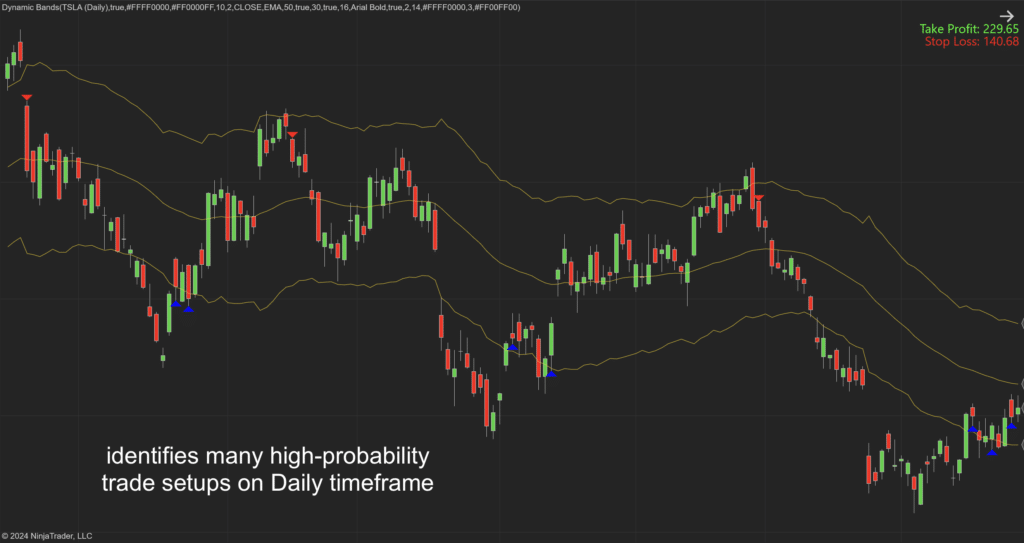
Built to go beyond standard Bollinger Bands, Dynamic Bands for NinjaTrader 8 offers a smarter way to track volatility and price movement. Its adaptive design responds quickly to changing conditions, helping reduce false signals and highlight high-probability setups. With clearer structure and more precise levels, it supports better timing and more confident trading decisions.
2.5. Volume Indicators
Volume indicators measure the number of shares or contracts traded during a specific period, helping traders understand how active the market is. In day trading, volume is used to confirm whether a price move is supported by strong participation. When price increases along with high volume, it suggests strong buying interest and a more reliable move. If price moves on low volume, it may indicate weak momentum or a false breakout. Traders also watch for sudden spikes in volume, which can signal the entry of institutional traders and potential trend continuation or reversal.
Why Volume Matters
Volume matters because it reveals the level of participation behind a move, helping traders judge how meaningful a price change really is. In day trading, markets can move quickly, but not all moves carry the same significance. Volume helps traders spot key moments, such as the start of a new trend, areas of strong interest, or potential exhaustion points. It also provides context during consolidations, showing whether the market is building energy for a breakout or simply drifting without conviction.
Advanced Alternative
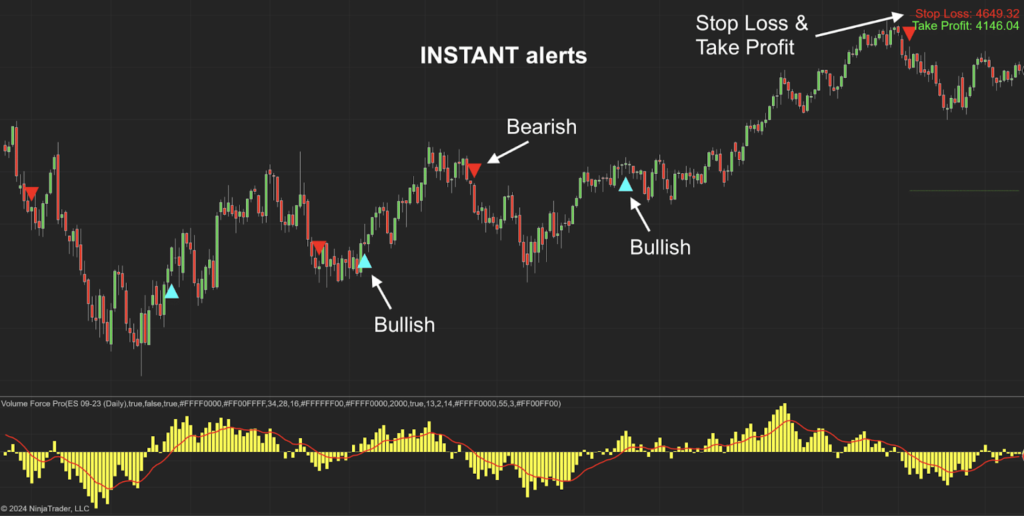
Traditional volume indicators only show how much is being traded, but Volume Force Pro for NinjaTrader 8 focuses on what that activity actually means. By combining price movement with volume data, it helps identify real buying or selling pressure. This makes it easier to confirm trends, spot reversals, and avoid weak or misleading price moves.
3. How to Combine Indicators for Day Trading
While individual indicators can be helpful, many traders achieve better results by combining multiple tools.
The goal is to use indicators that complement each other rather than duplicate the same type of analysis.
Common combinations include:
- Moving Average + RSI for trend and momentum
- MACD + Bollinger Bands for momentum and volatility
- Price Action + Volume indicators for breakout validation
4. Tips for Choosing the Best Indicators for Day Trading
Choosing the right indicators depends on your trading style, strategy, and experience level.
Here are some practical tips:
- Avoid Using Too Many Indicators: Too many indicators can create conflicting signals and make decision-making more difficult.
- Combine Different Types of Indicators: Try combining trend, momentum, and volume indicators rather than using multiple indicators from the same category.
- Backtest Your Strategy: Before trading with real money, test your strategy using historical data.
- Focus on Risk Management: Even the best indicators cannot eliminate risk. Always use proper position sizing and stop-loss orders.
The Bottom Line
In conclusion, the best indicators for day trading help traders navigate fast-moving markets by providing insights into trend, momentum, volatility, and volume. While no single tool guarantees success, combining multiple indicators can improve accuracy and confidence. The key is to test different strategies, stay disciplined, and use indicators as part of a well-rounded approach to short-term trading.
FAQs
1. Which indicator is the most accurate for day trading?
There is no single “most accurate” indicator. Every indicator has limitations. The best results come from combining 2–3 indicators, such as a trend indicator (moving average) with a momentum indicator (RSI or MACD) to confirm signals.
2. Can beginners rely on indicators for day trading?
Yes, but not entirely. Indicators can help beginners understand the market, but they should also learn price action, risk management, and discipline. Indicators should support decisions, not replace them.
3. Are lagging indicators bad for day trading?
No, lagging indicators are not bad. They help confirm trends rather than predict them. Many traders use lagging indicators like moving averages together with faster indicators to get more reliable signals.
4. How many indicators should a day trader use?
Most traders use 2 to 4 indicators. Using too many can create confusion and conflicting signals. It’s better to keep charts simple and use indicators that serve different purposes.
5. What is the biggest mistake day traders make?
The biggest mistake is overcomplicating their strategy – using too many indicators, ignoring risk management, or chasing trades. Successful traders focus on consistency, discipline, and a simple system.
Also, follow us for all the promotions and other useful topics:
- Facebook: www.facebook.com/craftindicators
- Instagram: www.instagram.com/craftindicators
